
The short answer
A ductless mini-split is a good fit when your central system can't cool a room, your home has no ductwork, or you want separate temperature control in different rooms. AirVantage checks the space, your electrical system, and where the units will go, then recommends and installs the right system, usually without major construction.
A ductless mini-split puts cooling exactly where you need it without running ductwork through your walls or attic. In Miami, air conditioning runs most of the year and summer humidity hangs heavy. A well-placed mini-split can cool a converted garage, a sunroom, or an addition, or it can cool an entire home room by room. AirVantage Heating & Cooling installs ductless systems for homeowners in Miami and nearby cities. This page explains when a mini-split makes sense, what we look at before recommending one, and what to expect on installation day.
Signs a Ductless Mini-Split Is Right for Your Home
Mini-splits solve specific problems. If any of these sound familiar, a ductless system is worth a conversation.
Muggy rooms are another clue. During Miami's wet season, from May through October, a room can feel damp even when the thermostat says it's cool. Mini-splits remove moisture as they cool. A properly sized unit runs long enough to pull humidity out of the air instead of turning on and off in short bursts.
- A room that never cools down, such as a bonus room over the garage or a west-facing space that bakes in the afternoon sun
- An addition, converted garage, or enclosed patio that isn't connected to your central system
- An older home with no ductwork, or ducts that are damaged, undersized, or impractical to replace
- Window or portable units that are loud, block light, and struggle to keep up with humidity
- High energy bills because you cool the whole house just to keep one or two rooms comfortable
- Family members who want different temperatures in different rooms
What We Check Before Recommending a System
A mini-split only works well if it's sized and placed for the room it serves. Before we recommend equipment, a technician walks the space and looks at the factors that determine the right choice.
We also ask how you use the space. A home office used during the day has different needs than a bedroom used at night, and that affects which unit we recommend and where it goes.
- Room size, ceiling height, and layout, including open areas that connect to other rooms
- Sun exposure, window size and orientation, and insulation levels
- Where the indoor unit can mount for even airflow without blowing directly on beds or seating
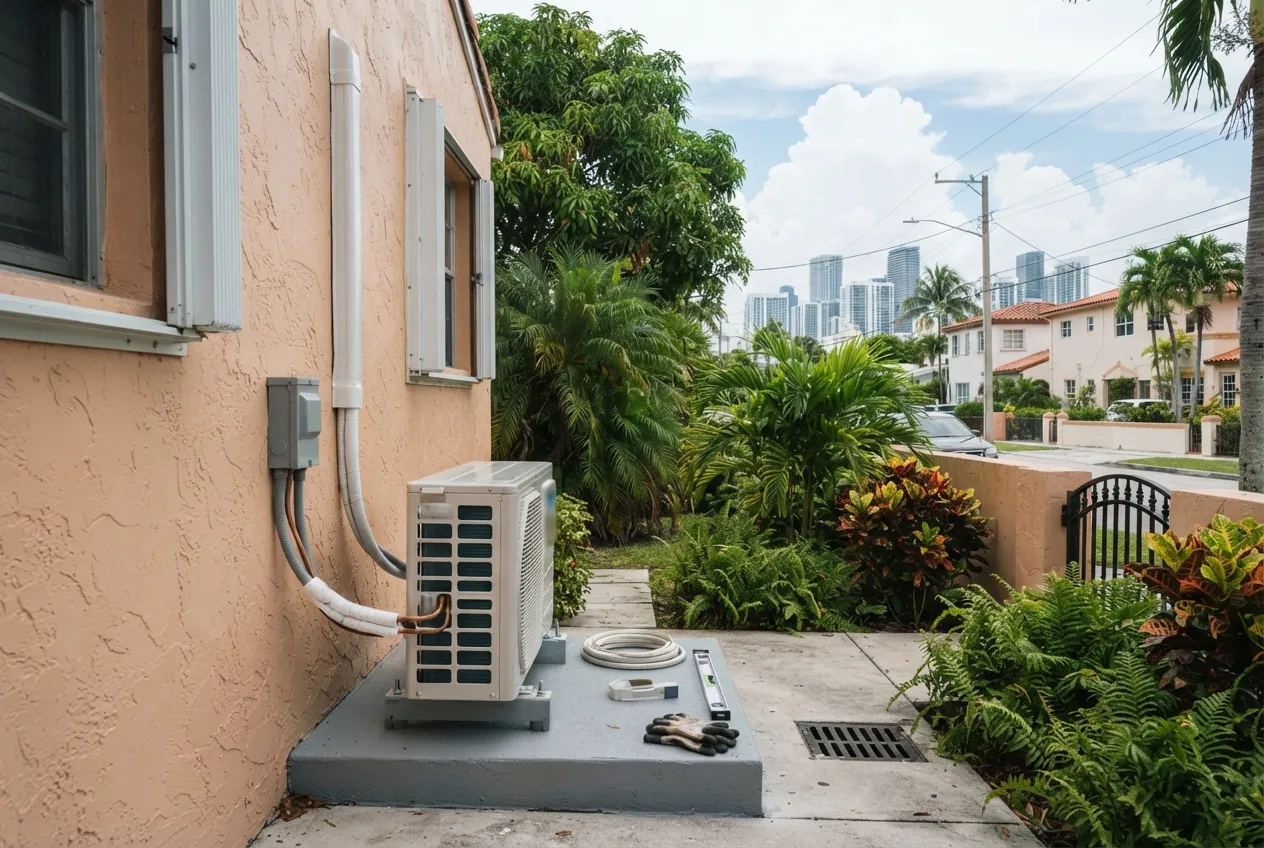
- A suitable spot for the outdoor unit, with enough clearance, drainage, and a stable pad or wall bracket
- The route for the refrigerant lines, condensate drain, and wiring between the indoor and outdoor units
- Your electrical panel's capacity and whether you need a new dedicated circuit
- How to secure the outdoor unit for hurricane season, which runs June 1 through November 30
Repair, Replace, or Add a Mini-Split
Not every comfort problem needs a new system. If you already have a mini-split that isn't keeping up, we start by diagnosing it. Common fixable problems include dirty filters and coils, clogged condensate lines, low refrigerant from a leak, and failed sensors or control boards. If the repair is straightforward and the rest of the system is in good shape, repair is usually the sensible choice.
Replacement makes more sense when the unit has a major component failure, keeps leaking refrigerant, or simply can't handle the room's cooling needs. Salt-air corrosion on the outdoor coil is another reason to replace. Older systems may also use a refrigerant that is harder and more expensive to service.
If you have central air and only a few rooms are a problem, adding a mini-split for those rooms may be more practical than replacing the whole central system. We'll lay out the options side by side so you can decide.
What Affects the Cost of Installation
We quote every installation after we see the home, because the details change the scope of the job. The main cost factors are:
Rebates may help offset the cost. Florida Power & Light runs a Residential HVAC program that offers rebates on qualifying high-efficiency central air conditioners and heat pumps. The rebates are delivered through participating contractors at the time of installation. We'll check whether the system you choose qualifies and confirm the current terms before including a rebate in your quote. The federal Energy Efficient Home Improvement Credit (25C) only covered qualifying heat pumps placed in service before December 31, 2025, so you can't claim it for a new installation.
- The number of rooms (zones) and indoor units, and whether they connect to one outdoor unit or several
- Equipment capacity and efficiency rating
- Type of indoor unit: wall-mounted, ceiling cassette, floor console, or concealed ducted
- Length and route of the refrigerant lines, and how much wall or ceiling work it takes to run them neatly
- Electrical upgrades, such as a new circuit or panel work
- Outdoor mounting, including pads, wall brackets, or raised stands
- Condensate drainage, especially if the system needs a pump to remove water
How an Installation Visit Works
Here's what to expect from your first call to the final walkthrough.
A simple single-room installation can often be completed in one day. Systems that serve several rooms take longer. If we need access to your attic or crawlspace, we'll let you know ahead of time.
Ready to cool the rooms your central air misses? Contact AirVantage Heating & Cooling to schedule an assessment.
- Assessment: A technician visits, measures the space, checks your electrical system, and talks through how you use each room.
- Recommendation and quote: You get a written proposal showing the equipment, where each unit will go, and the scope of work.
- Installation day: We mount the indoor and outdoor units and drill a small opening through the wall for the lines. Then we run the refrigerant and drain lines and complete the electrical connections.
- Testing: We pressure-test the lines for leaks, vacuum out air and moisture, and charge the system. Then we check airflow, temperature, and drainage.
- Walkthrough: We show you how to use the remote, set modes, and clean the filters, and we clean up the work area before we leave.